Battle of Kalkheuwel
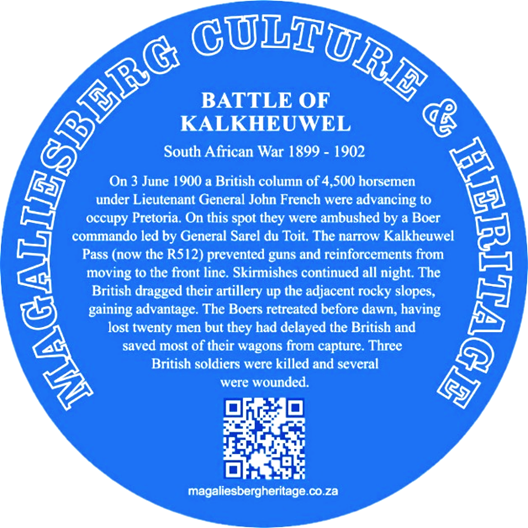
The first battle of the South African War to be fought in the Magaliesberg area
Unveiled 26 January 2018
by Maarten Stols, great grandson of one of the Boer burgers who took part in the battle.
Locality
Travel north on the R512 for 14kms past Lanseria Airport. The Blue Plaque is located in the garden of the the Lion and Safari Park which is on the right.
What can be seen
The Lion and Safari Park lies at the epicentre of the battle which took place in the surrounding hills. Remnants of stone fortifications and a military road can be seen on the hills opposite the entrance to the Lion and Safari Park. The stream-bed outside the Wetlands Restaurant was one of the few places where the British horsemen took cover while under fire. A large-scale map of the South African War is exhibited next to the Blue Plaque.
THE BATTLE OF KALKHEUWEL – 3 JUNE 1900
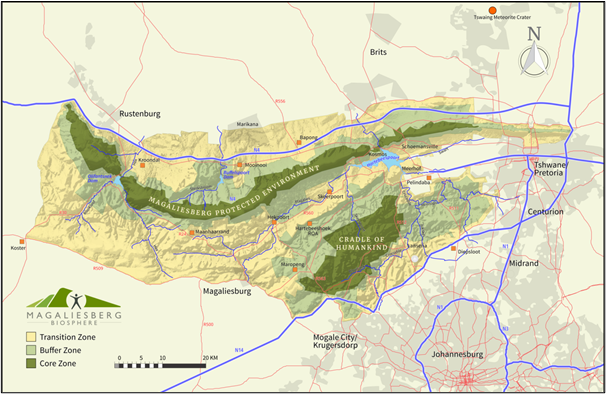
Location of the Battle of Kalkheuwel in the Magaliesberg Biosphere Reserve
Narrative
At the start of the South African War in 1899 the Boers won a series of early victories, but in early 1900 the military tide turned and by June the British, under the supreme command of Lord Frederick Roberts, were preparing to enter Pretoria, capital of the Transvaal Republic.
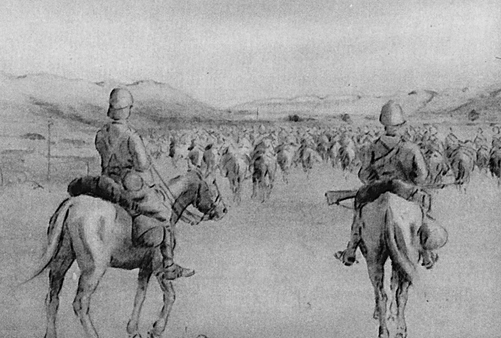
General French’s column approaching Kalkheuwel
While Lord Roberts approached Pretoria along the man Johannesburg-Pretoria Road, Lieutenant-General Sir John French led a column of 4,500 horsemen to encircle the capital from the west. The column comprised several celebrated cavalry regiments, the Royal Horse Artillery and numerous Canadians and Australians.
Their route followed what is now the R512 highway to Broederstroom. The British had earlier spotted a convoy of Boer supply wagons ahead and at about 16:00 the British column followed them into the Kalkheuwel Pass.
In 1900 the pass was a narrow wagon track with verges strewn with dolomite boulders, treacherous for horses, so the column was confined to the wagon track that followed the stream bed. In the late winter afternoon long shadows added to the menace of the rugged landscape and General French was anxious to get through the pass before dark.
Unknown to the British, about 600 Boers of the Wolmaranstad and Groot Marico Commando under Field-General Sarel du Toit lay hidden a few hundred metres beyond the modern Lion and Safari Park. Further down the pass towards Broederstroom, the Boers had positioned two Krupp field guns.
As the column approached the pass, French ordered a squadron of the 6th Inniskilling Dragoons to climb the slopes of the Kalkheuwel hill to cover the rest of the column as it moved along the road below. Leaving their horses behind them the Inniskillings reached the high ground at 16.30, just as the main column entered the narrowest part of the pass.
At that moment the Boers revealed themselves and opened fire.
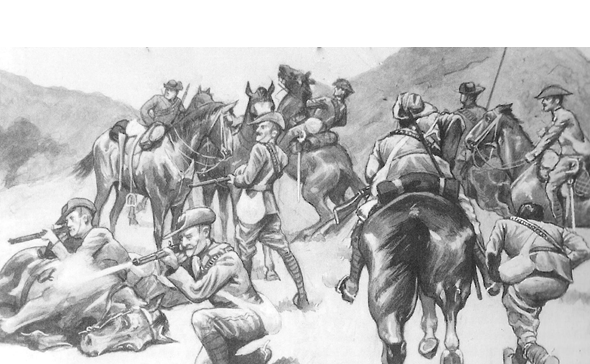
Battle of Kalkheuwel. Front ranks of British column under fire.
Two men at the front of the column were killed immediately and another was mortally wounded. For a short while there was pandemonium on the congested track. Lieutenant J.W. Morton wrote in his diary:
‘The noise was deafening: guns, pom-poms, Mauser and our own fire – one continuous roar, echoed and re-echoed amongst the hills.’
But Major Lee of the New South Wales Lancers distinguished himself by rallying his men and ordering them to take cover in the stream-bed or behind dead horses that offered some protection from the deadly Boer shell and rifle fire.
Slightly further back along the road, near the present Alpha Training Centre, the Royal Horse Artillery had difficulty as their horses stumbled over the rough terrain and suffered dreadfully from shrapnel and rifle fire.
Gradually order was restored but sniping continued from both sides until well after dark as men fired at each other’s rifle flashes. Throughout the night Father Knapp, a Carmelite chaplain, moved heroically among the men, helping the wounded and giving encouragement.
The moon set before midnight and the Boer commandos were able to withdraw quietly under cover of pitch darkness. Eleven of their twenty-five wagons had been destroyed but the remaining 14 escaped safely to the Bushveld beyond the Magaliesberg range. They had taken a heavy toll but the Boers customarily removed their dead from the battlefield to be buried on their family farms, so the actual Boer loss will never be known.
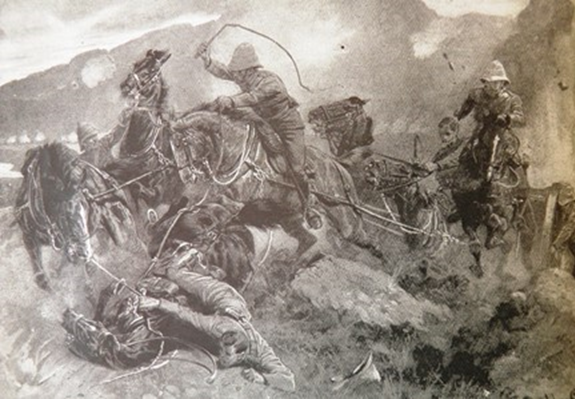
Royal artillery unable to position guns.
The following morning French took stock of the situation. Incredibly, only three men, Sergeant W. Belshaw, Cpl. A Blackman and Pvt Hall, had been killed and several others were wounded, but the carnage among the horses was pitiable. Many were dreadfully injured and had to be shot to spare them further misery.
The three men were buried in the nearby farm cemetery. In 1962 after an incident of vandalism, all outlying graves of British soldiers in the Magaliesberg were exhumed and re-interred in the Rietfontein military cemetery on the banks of the Hartbeespoort Dam. Their names are recorded on a centaph in the centre of the cemetery.
Famous men who took part in the Battle of Kalkheuwel
- General Sir John French, Commanding Officer at the Battle, became the Commander-in-Chief of the British expeditionary army that went into France at the start of the First World War in 1914.
- Edmund Allenby, Officer Commanding the 6th Inniskilling Dragoons at Kalkheuwel, became Field Marshal Viscount Allenby who liberated Jerusalem from seven hundred years of Ottoman rule in 1917.
- Major (later Colonel) James Stevenson-Hamilton of the 6th Inniskillig Dragoons was later the founder of the Kruger National Park.
- Captain Lawrence Oates of the Inniskilling Dragoons was part of the ill-fated Scott expedition to the Antarctic in 1915. Crippled with frostbite, he voluntarily chose to die in the blizzard rather than hinder the expedition.
Further reading
Amery, LS, ed. The Times History of the War in South Africa: 1899-1902. Vol IV. London: Sampson Low, 1906.
- A comprehensive, seven-volume history of the entire South African War that allows the reader to see the Battle of Kalkheuwel in the broader context of the war as a whole.
Carruthers, V., The Battle of Kalkheuwel. Private publication: Magaliesberg Heritage Series, 2018.
Copley, I.B., ’Ambush at Kalkheuwel’, Military History Journal 9 (4), 1993. Available online.
- A detailed account of the battle with well researched information and a comprehensive list of references.
Milne, R., The Battle of Dwarsvlei 11 July 1900. Private publication: Magaliesberg Heritage.
- An illustrated account of the battle.